
What Is the Best Robotic Hair Transplant in 2027? A Guide to the FUEsion X System
People searching for what is the best robotic hair transplant in 2027 are often comparing technology, treatment methods, and clinics. There is no single system that is best for every patient. The right choice depends on the person’s hair and scalp, donor supply, treatment goals, and the skill of the medical team.
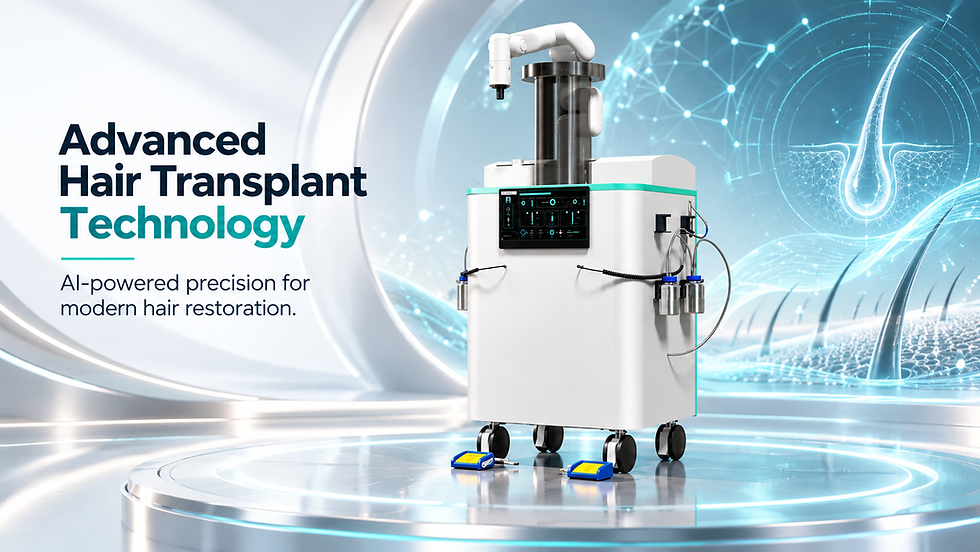
The FUEsion X Robotic Hair Transplant System brings together artificial intelligence (AI), computer vision, a robotic arm, augmented reality (AR) glasses, extraction tools, graft storage, and an automated implanter. It is designed to assist clinicians during several stages of Follicular Unit Extraction (FUE), from planning through graft placement.

These tools can support the clinical workflow, but they do not make treatment decisions independently or guarantee a particular result. A qualified clinician must assess each patient, explain the available options, and determine whether transplantation is appropriate.
What Does Robotic Hair Transplantation Involve?
FUE is a hair transplant method in which follicular units are extracted individually from a donor area, usually at the back or sides of the scalp, and placed in areas where additional coverage is desired. Each follicular unit may contain one or several hairs.
Although the procedure uses specialized equipment, it also requires careful judgment. The clinical team must consider the donor supply, hair-loss pattern, hair characteristics, desired coverage, and long-term plans. During extraction and placement, the surgeon must also consider graft handling, angle, direction, depth, and spacing.
Robotic and AI-assisted systems are designed to support parts of this process. Their capabilities differ. Some systems automate selected tasks, while others provide tools that help a clinician visualize, plan, or track the procedure. The FUEsion X system is designed as a surgeon-led system with robotic assistance, rather than a machine that makes all treatment decisions on its own.
FUEsion X features at a glance
The system brings together tools intended to assist with consultation, donor-area assessment, extraction, graft handling, and implantation. Its features include:
HAIR STUDIO, an AI-powered hair result simulation tool.
An AI camera with up to 50× magnification.
AI-assisted donor-area and graft analysis.
A robotic arm with five degrees of freedom.
AR glasses for magnified live visualization.
Two-sided suction-assisted extraction.
Low-speed handpieces and guarded safety punches.
Cold storage chambers for extracted grafts.
A 15-inch touchscreen and automatic graft counter.
An AI implantation planning tool.
A pneumatic automated implanter.
Machine Talk voice controls.
Each feature has a specific role in the intended workflow. Their usefulness depends on how they are applied by the clinical team and whether they suit the patient’s plan.
AI-powered HAIR STUDIO for Consultation Planning
A hair transplant plan begins with an assessment of the patient’s goals, donor area, hair-loss pattern, and possible coverage. HAIR STUDIO is designed to use the patient’s photographs to simulate potential hair-restoration plans. The tool can help the surgeon discuss different coverage areas and graft allocations with the patient.
During consultation, a simulation may help the team:
Discuss possible hairline and coverage approaches.
Consider estimated graft needs for different plans.
Compare options with different coverage goals.
Talk through how donor supply may affect the plan.
Help the patient visualize potential changes on their own photographs.
A simulation can make a complex conversation more visual, but it is not a guarantee or exact preview of the final result. Hair characteristics, healing, graft growth, future hair loss, and the patient’s anatomy can all affect the outcome. The surgeon should explain what the simulation illustrates and where uncertainty remains.
AI Camera with up to 50× Magnification
The FUEsion X system includes an AI camera with up to 50× magnification. The camera is designed to provide a closer view of the donor area and follicular units while the surgeon works. Magnified visualization can help the clinician inspect follicle orientation and angulation, which may vary across the scalp.
A closer view may be useful when assessing fine, wavy, curly, or otherwise challenging hair characteristics. The camera can support observation, but the surgeon still interprets what is visible and decides how to proceed.
Magnification alone does not prevent graft damage or ensure a specific graft yield. FUE involves individual variation in anatomy and follicle direction. The patient’s characteristics, the surgeon’s technique, and the clinical team’s experience remain important parts of the process.
AI-Assisted Donor-Area Analysis
The system is designed to assist with analysis of the donor area and follicular units, including grafts containing one, two, three, or four hairs. This information may help the surgeon consider how different graft types could be used in different recipient areas.
Graft selection can be part of creating a natural-looking plan. For example, a surgeon may consider finer grafts for the front hairline and other graft types for areas where coverage is being planned. The appropriate allocation depends on the patient’s hair, donor supply, treatment goals, and clinical judgment.
AI-assisted analysis can help organize information and highlight characteristics for the surgeon to review. It does not replace assessment of the scalp, medical history, donor capacity, future hair loss, or other factors that may affect candidacy and treatment planning.
Five-Degree-of-Freedom Robotic Arm
The FUEsion X system includes a robotic arm with five degrees of freedom. It is designed to move the AI camera toward targeted areas of the donor scalp, scan the working area, and help keep the operative field in view.
The arm can also track the surgeon’s handpiece during extraction. The system specifies tracking accuracy of 0.1 mm; this is a technical specification, not a guarantee of clinical accuracy or a particular result. Its role is to assist with positioning and visualization while the surgeon remains actively involved in the procedure.
This is a human-assisted approach to robotic support. The system is designed to help the clinician work with camera movement and tracking, while the surgeon retains responsibility for assessing the patient, guiding extraction, and making decisions during treatment.
AR Glasses for Live Visualization and Posture Support
The AR glasses are designed to display a magnified live feed in front of the surgeon. This can help keep the donor area visible without requiring the clinician to repeatedly bend toward a separate viewing point.
Potential workflow benefits include:
Maintaining a live view while working.
Reducing the need to shift attention between the patient and a separate display.
Supporting a more upright posture during lengthy procedures.
Helping the surgeon follow the extraction area as it changes.
A more comfortable working position may support the clinician during a procedure that requires sustained concentration. The glasses do not replace surgical training, careful technique, or appropriate operating-room protocols.
Two-Sided Suction-Assisted Extraction
The system features two-sided suction-assisted extraction, designed to combine graft scoring and extraction into a streamlined workflow. The goal is to support efficient harvesting while allowing the surgeon to remain attentive to graft handling and the donor area.
Procedure length varies from patient to patient. The number of grafts, anatomy, hair characteristics, the plan, and the clinical team’s experience all influence how long treatment takes. A feature designed to improve efficiency does not mean every procedure will be shorter by a fixed amount.
Efficiency should always be balanced with careful technique. The surgeon must adapt the approach to the patient and the area being treated rather than prioritize speed alone.
Safety Handpieces and Guarded Punches
The FUEsion X system includes low-speed handpieces and safety punches with a guard intended to help standardize insertion depth. The punch design aims to support controlled extraction and careful handling of surrounding tissue.
These features may assist the surgeon in maintaining a consistent approach, but no tool eliminates all risks. Hair transplantation may involve graft injury, scarring, healing concerns, infection, or other complications. The medical team should explain relevant risks and recovery expectations before the patient decides to proceed.
Punch selection and technique should be based on the patient’s hair and scalp characteristics, the donor area, and the treatment plan. Donor preservation is also important: the extraction strategy should consider how the donor region may look after healing and what supply may be needed in the future.
Cold Storage Chambers for Graft Handling
Extracted grafts need appropriate handling before implantation. The system includes cold storage chambers intended to help prevent grafts from drying while they are outside the body and waiting to be placed.
Storage is one part of graft management. Sorting, hydration, timing, and implantation technique also matter. The presence of a cold storage chamber cannot guarantee graft survival or future growth. Patients can ask their clinic how grafts are handled throughout the procedure and what protocols the team follows.
Touchscreen Controls and Automatic Graft Counting
A 15-inch touchscreen is designed to give the surgeon access to operating controls and procedure information. The system also displays an automatic graft count, helping the team monitor the number of extracted grafts as the procedure progresses.
Tracking can support organization and help the clinical team compare progress with the treatment plan. A graft count alone does not show whether each graft is suitable for a particular area or predict the final density. The surgeon must interpret the information and decide how to proceed.
The touchscreen allows settings to be adjusted and customized. These controls are intended to make system operation more accessible to the clinical team, while the surgeon remains responsible for selecting settings appropriate to the procedure.
AI Implantation Planning
The AI implantation tool is designed to help estimate graft needs based on selected coverage and density goals. It can also assist with assessing donor-area availability and considering how different types of grafts might be distributed across recipient areas.
This planning support can help the surgeon and patient discuss what may be achievable. A treatment plan must account for donor limitations, hair characteristics, the patient’s pattern of hair loss, and possible future loss. The surgeon should review and adapt any technology-generated estimate before making a final plan.
Atraumatic Automated Implantation
The system includes the FUEsion Atraumatic Automated Implanter, which uses a pneumatic mechanism to support graft placement. It is designed to implant grafts without first creating separate slits or channels. The implanter can be loaded with up to 100 grafts consecutively, according to its stated design.
The tool aims to support controlled placement and standardized depth. Implantation also involves decisions about angle, direction, spacing, and hairline design. These choices influence how natural the result may look, so the surgeon’s planning and oversight remain essential. The pace and number of grafts handled in sequence may vary by patient and clinical team.
Machine Talk Voice Control
Machine Talk technology allows the system to respond to voice commands. Hands-free controls may let the surgeon adjust selected functions without reaching for manual controls during the procedure.
Voice control is a workflow feature; it does not replace infection-control protocols or sterile technique. The clinical team remains responsible for following appropriate procedures throughout treatment.
Potential advantages of the FUEsion X system
The system brings tools for planning, visualization, extraction, graft handling, and implantation into one workflow. Potential advantages of its design include:
Visual planning support: HAIR STUDIO can help patients and surgeons discuss potential coverage plans using photographs.
Magnified visualization: The AI camera and AR glasses are designed to support a closer view of the donor area.
Organized graft assessment: AI-assisted analysis may help the team review graft characteristics.
Robotic camera assistance: The arm supports camera movement and tracking while the surgeon remains involved.
Procedure tracking: The touchscreen and graft counter can help the team monitor progress.
Graft-handling support: Cold storage chambers are intended to help prevent extracted grafts from drying.
Ergonomic support: AR visualization and camera movement may reduce repeated posture changes.
Implantation assistance: The automated implanter is designed to support graft placement.
Hands-free operation: Voice commands may help the team control selected functions.
These are intended design benefits, not guarantees of higher density, greater graft survival, fewer complications, or a particular cosmetic result. Outcomes vary between patients.
What is the Best Robotic Hair Transplant in 2027
When evaluating what is the best robotic hair transplant in 2027, look at the overall treatment approach as well as the equipment. A system may have advanced features, but its value depends on appropriate use by a trained clinical team and a plan suited to the patient.
During a consultation, patients can ask:
Who will assess the donor area and design the treatment plan?
Who will perform extraction and implantation?
How will graft needs and donor availability be evaluated?
What does a photo simulation show, and what can it not predict?
How are grafts handled between extraction and implantation?
What risks, recovery expectations, and limitations apply to this case?
Can the clinic show results from patients with similar hair characteristics and goals?
A clinic should answer these questions clearly and help the patient understand what is realistic. Technology can support a workflow, but the surgeon’s assessment, experience, and execution remain central.
Conclusion
The best robotic hair transplant system in 2027 is not determined by automation alone. It should support careful planning, clear visualization, appropriate graft handling, and clinician-led treatment. The FUEsion X Robotic Hair Transplant System combines AI-assisted planning and analysis, magnified imaging, robotic camera support, AR glasses, extraction tools, cold storage, touchscreen controls, voice commands, and an automated implanter.
These features are designed to assist clinicians across several stages of FUE treatment. Whether they are right for a particular patient depends on an individualized assessment, the medical team’s expertise, and realistic expectations. Patients considering hair transplantation should discuss candidacy, risks, and likely outcomes with a qualified clinician.
Medical Information Notice/ Medical Information Disclaimer
This content is provided for general educational purposes only and reflects the clinical experience and protocols followed at I Brain Robotics. It is not a substitute for professional medical advice, diagnosis, or treatment. Patients are advised to consult a qualified hair restoration specialist for personalized recommendations.


Comments