.png)
Non Surgical Hair Restoration Procedure: The Future of Hair Rejuvenation Technology
Hair loss affects millions of men and women globally, often causing significant psychological distress, reduced self-esteem, and social anxiety. For decades, the primary solutions available to patients were limited to topical pharmaceuticals with varying efficacy or invasive surgical procedures that required significant recovery time. While surgical hair transplantation remains the gold standard for restoring density in balding areas, a new paradigm has emerged for patients seeking preventative care, early-stage intervention, or non-invasive maintenance. This paradigm is non-surgical hair restoration.

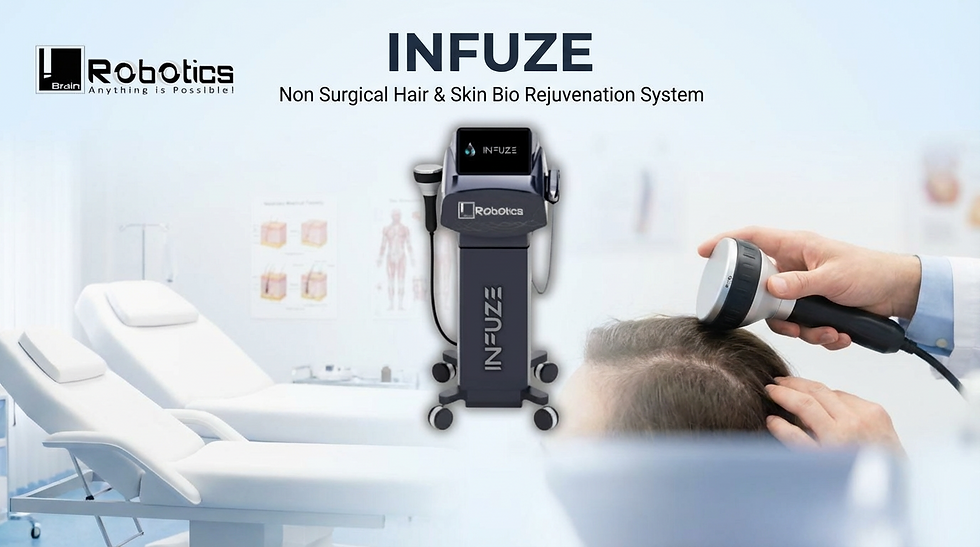
The landscape of aesthetic medicine is rapidly evolving, driven by technological advancements that prioritize patient comfort without compromising clinical outcomes. Today, we stand at the threshold of a new era where needles, anesthesia, and downtime are no longer prerequisites for effective hair rejuvenation. Modern biomedical engineering has given rise to sophisticated delivery systems capable of permeating the skin's protective barrier safely and effectively. At the forefront of this revolution is i-Brain Robotics, a company pioneering the integration of artificial intelligence and advanced physics into aesthetic treatments. Their flagship non-surgical solution, the InFuze™ system, represents a significant leap forward, offering a needle-free alternative that promises to redefine the standards of scalp care and hair preservation.
What is Non-Surgical Hair Restoration?
Non-surgical hair restoration encompasses a broad category of treatments designed to stimulate hair follicles, improve scalp health, and promote hair growth without the need for surgical incisions or graft extraction. Historically, this category was dominated by topical solutions such as minoxidil or oral medications like finasteride. While effective for some, these traditional methods often suffer from issues related to absorption, patient compliance, and systemic side effects.
As the demand for less invasive cosmetic procedures grew, the industry responded with therapies like Platelet-Rich Plasma (PRP) injections and Low-Level Laser Therapy (LLLT). PRP, while potent, typically requires blood draws and multiple painful scalp injections, which can deter patients with needle phobias. LLLT offers a painless alternative but often requires long-term, daily commitment with variable results.
The modern definition of non-surgical hair restoration has expanded to include advanced transdermal delivery systems. These technologies aim to bridge the gap between topical applications and invasive injections. The core challenge in any topical treatment is the stratum corneum—the outermost layer of the skin designed by evolution specifically to keep foreign substances out. Traditional creams and serums often sit on the surface, with only a fraction of the active ingredients penetrating deep enough to reach the hair follicle bulb where regeneration occurs.
Advanced non-surgical systems utilize physical forces—such as ultrasound, radiofrequency, or pneumatic pressure—to temporarily bypass this barrier. By doing so, they ensure that therapeutic agents (such as growth factors, peptides, exosomes, or pharmaceutical compounds) are deposited directly into the dermis. This evolution marks a transition from passive treatment methods to active, technology-driven delivery systems that maximize bioavailability and clinical efficacy.
InFuze™ Technology: Revolutionary Needle-Free Hair Restoration
At the cutting edge of non-surgical innovation stands the InFuze™ system by i-Brain Robotics. Designed as a direct response to the limitations of traditional needles and passive topicals, InFuze represents a breakthrough in transdermal delivery technology. It is engineered specifically to address the needs of patients suffering from hair thinning, shedding, and androgenetic alopecia, as well as those seeking general scalp revitalization.
The InFuze system distinguishes itself through a sophisticated dual-technology approach. Unlike simple jet injectors or standalone ultrasound devices, InFuze combines ultrasonic physics with pneumatic pressure to achieve deep dermal penetration. This synergy allows for the delivery of high-molecular-weight compounds that would otherwise be unable to penetrate the skin's surface.
The Dual-Technology Mechanism
The core innovation of InFuze lies in its ability to manipulate the skin's barrier function temporarily and reversibly. The system operates on two fundamental principles:
Ultrasonic Permeation: The device emits low-frequency ultrasonic sound waves. These waves interact with the lipids in the stratum corneum, creating transient micro-channels. This physical phenomenon, known as sonophoresis, significantly increases the permeability of the skin, "prepping" the tissue to receive the therapeutic solution.
Pneumatic Propulsion: Simultaneously, the system utilizes Transdermal Application (TDA) principles to generate pressurized bursts of air. These bursts propel the active ingredients at high velocities, turning the liquid solution into a fine stream of micro-droplets.
By integrating these two mechanisms, InFuze ensures that the active ingredients are not merely sprayed onto the skin but are actively pushed through the stratum corneum and into the dermis. This is critical because the target for hair restoration—the hair follicle bulb and the dermal papilla—resides deep within the skin structure. Reaching this depth without a needle is a significant biomedical engineering achievement.
The InFuze system is also versatile. While its primary application is hair restoration, its mechanism is equally effective for skin rejuvenation. The technology can deliver hyaluronic acid, vitamins, and antioxidants to the face and neck, offering a holistic approach to aesthetic maintenance. For hair restoration specifically, this means that potent growth factors and nutrients can be delivered directly to the follicle without the trauma, bleeding, or risk of infection associated with mesotherapy or microneedling.
How InFuze Works: Non Surgical Hair Restoration Procedure
Understanding Non Surgical Hair Restoration Procedure: the efficacy of the InFuze system requires a closer look at the physics governing its operation. The process is a carefully choreographed sequence of events designed to maximize absorption while maintaining absolute patient comfort.
Step 1: Ultrasonic Permeabilization
The treatment begins with the application of the device's handpiece to the target area. The system generates ultrasonic waves at a frequency of 40 kHz. At this specific frequency, the sound waves create a cavitation effect within the lipid bilayer of the stratum corneum. This effect temporarily disrupts the tightly packed skin cells, creating microscopic pathways or "channels." These channels are invisible to the naked eye and cause no structural damage to the tissue, yet they are sufficient to allow large molecules to pass through.
Step 2: High-Velocity Transdermal Application (TDA)
Once the skin is permeabilized, the pneumatic component of the system engages. The device generates pulsed micro-bursts of the active solution. These are not continuous sprays but controlled, high-energy pulses. The liquid is accelerated to speeds of up to 450 meters per second (m/s). At this velocity, the kinetic energy of the micro-droplets allows them to penetrate the skin through the channels created by the ultrasound, as well as through natural pores and hair follicles.
Step 3: Precision Deposition
Crucial to this process is the design of the applicator. The InFuze handpiece features a sealed-contact vacuum applicator with a microcrystal head. This design ensures that the high-velocity stream is directed precisely perpendicular to the skin surface. The vacuum component gently lifts the skin, stabilizing the tissue and bringing the dermal layer closer to the nozzle. This ensures that the energy is not dissipated and that the active ingredients are deposited at the correct depth—typically reaching the dermal-epidermal junction and the deeper reticular dermis where hair follicles are rooted.
The entire process occurs rapidly and painlessly. The patient feels only a sensation of cool air or slight pressure. Because the barrier disruption is temporary, the micro-channels close shortly after the treatment, locking the active ingredients inside the tissue where they can exert their therapeutic effects over time.
Benefits for Patients
For patients facing hair loss, the psychological burden is often compounded by the fear of painful or invasive treatments. InFuze addresses these concerns directly, offering a patient-centric solution with several compelling benefits.
Non-Invasive & Painless Experience
The most immediate benefit is the total absence of needles. For the millions of individuals with trypanophobia (fear of needles), this opens the door to treatments they would otherwise avoid. The procedure is atraumatic, meaning it causes no pain, bleeding, or tissue damage. Patients describe the sensation as a relaxing scalp massage or a cool breeze, a stark contrast to the discomfort of multiple scalp injections.
Zero Downtime
In today's fast-paced world, downtime is a luxury many cannot afford. Surgical hair transplants typically require days of recovery, and even PRP treatments can leave the scalp sore or inflamed. With InFuze, there is absolutely zero downtime. Patients can schedule a session during their lunch break and return to work or social activities immediately afterward without any visible signs of treatment. There are no bandages, no scabs, and no restrictions on washing hair.
Uniform Distribution of Nutrients
Manual injections are prone to human error, often resulting in "pooling" of the solution in specific spots while leaving adjacent areas untreated. The automated, pulsed delivery of the InFuze system ensures a perfectly uniform distribution of actives across the entire treatment zone. This homogeneity ensures that every hair follicle in the target area receives the necessary nutrients, leading to more consistent and aesthetically pleasing results.
Broad Suitability
InFuze is an inclusive technology. It is safe and effective for all skin types (Fitzpatrick I-VI) and all hair textures. It can be used on men and women alike, regardless of the stage of hair loss—from early thinning prevention to maintenance after a surgical transplant.
Benefits for Physicians and Clinics
For aesthetic practitioners and hair restoration clinics, incorporating InFuze technology offers operational and clinical advantages that enhance practice growth and reputation.
Enhanced Patient Safety Profile
Safety is a primary concern for any medical provider. By eliminating needles, InFuze removes the risks associated with sharps handling, including accidental needle sticks and cross-contamination. It also eliminates the risk of patient infection, bruising, or hematoma formation at the injection site. This superior safety profile makes the treatment suitable for delegation to trained support staff, optimizing clinic workflow.
Expanding the Patient Base
Many potential patients are interested in hair restoration but are not candidates for surgery or are unwilling to undergo invasive procedures. InFuze allows clinics to capture this substantial market segment. It provides an effective entry-level therapy that can convert hesitant patients into long-term clients. Furthermore, it serves as an excellent adjunct therapy for post-transplant patients, helping to nurture the graft area and improve overall density without traumatizing the newly implanted follicles.
Consistent Clinical Protocols
The InFuze system supports standardized, provider-directed protocols. The controlled delivery parameters (pressure, frequency, dosage) reduce variable outcomes that depend on operator technique. This consistency allows clinics to offer reliable results, building trust and encouraging patient retention through maintenance programs.
Other Advanced Robotic Hair Restoration Technologies by i-Brain Robotics
While InFuze revolutionizes non-surgical care, i-Brain Robotics is also a global leader in surgical automation. The company has developed a comprehensive ecosystem of robotic and AI-assisted devices that modernize every aspect of hair transplantation.
HARRTS FUEsion X 5.0 - Robotic Hair Transplant System
The FUEsion X 5.0 represents the pinnacle of robotic hair restoration. It is designed to assist surgeons in performing Follicular Unit Excision (FUE) with unprecedented precision and speed. Unlike older robotic systems that are bulky and excessively expensive, the FUEsion X combines versatility with advanced AI at a more accessible price point.
AI & Augmented Reality (AR): The system features AR glasses that project a 120-inch stereoscopic 3D view of the surgical field directly to the surgeon's eyes. This eliminates the need for the surgeon to hunch over a microscope, reducing postural fatigue.
5-DOF Robotic Arm: A highly sensitive robotic arm with five degrees of freedom mimics human hand movements but with 0.1mm accuracy tracking, stabilizing the extraction process.
AI Result Simulation: The integrated "Hair Studio" and "FUE-GEN AI Simulator" allow surgeons to simulate post-procedure results on the patient's own photos, managing expectations and planning hairline designs with high accuracy.
Dual-Sided Extraction: The unique extraction system is designed to perform procedures at twice the speed of conventional devices, reducing the time grafts spend outside the body (ischemia time) and thereby improving survival rates.
HARRTS FUEsion AI - Automated AI Hair Transplant System
For clinics that require high-level automation without the full robotic arm interface, the FUEsion AI system offers a powerful alternative. This system leverages computer vision algorithms to streamline the workflow.
AI Donor Analysis: The system analyzes the donor area in real-time, identifying 1, 2, 3, or 4-hair follicular units. This assists the surgeon in selecting the best grafts for specific areas (e.g., single hairs for the hairline, multi-hair units for density).
Atraumatic Workflow: It integrates with the FUEsion atraumatic implanters, ensuring that the transition from extraction to implantation is seamless and minimally invasive.
HARRTS FUEsion Lite - Automated Hair Transplant System
Recognizing that not all clinics are ready for full-scale robotics, i-Brain Robotics offers the FUEsion Lite. This entry-level automated solution brings the benefits of suction-assisted extraction to a wider range of practices.
Cost-Effective Automation: It provides the core benefits of standardized, suction-assisted extraction (reducing follicle damage) at a mid-range price point.
Standardized Procedures: It allows clinics starting with hair restoration to offer consistent, high-quality results from day one, minimizing the learning curve associated with manual FUE punches.
Automated Implanter Technologies
Perhaps one of the most significant innovations is the FUEsion Atraumatic Automated Implanter. Traditional implantation requires creating pre-made slits in the scalp with a scalpel, followed by manual insertion of grafts with forceps—a process that can crush fragile follicles.
The i-Brain Robotics implanters are "stick-and-place" devices that allow for the consecutive implantation of up to 100 grafts without creating separate slits. This method significantly reduces trauma to the scalp, minimizes bleeding, and ensures that the grafts are placed at the exact depth and angle required for a natural look. The "Multi-root" capability ensures that even bulky, multi-hair grafts are accommodated safely.
Treatment Protocols and Expected Results
Success in non-surgical hair restoration relies on consistency. The InFuze system is designed for a course of treatment rather than a one-time fix. While individual physiology varies, standard clinical recommendations have been established to maximize efficacy.
Initial Course
A standard protocol typically involves an initial series of 3 to 6 sessions, spaced approximately 4 weeks apart. This "loading phase" is designed to kickstart the rejuvenation process, waking up dormant follicles and improving the vascularization of the scalp.
Timeline and Maintenance
Patients should be counseled that hair restoration is a biological process that takes time. Visible improvements—such as reduced shedding, increased hair caliber (thickness), and improved scalp health—are typically noticed after the completion of the initial 3-session block. To sustain these gains, ongoing maintenance sessions are advised, typically once every 3 to 6 months depending on the severity of the condition.
Progress monitoring is essential. Clinics utilizing InFuze often employ trichoscopy or standardized photography to track changes in hair density and shaft diameter, providing objective data to support the subjective improvements reported by patients.
Conclusion
The field of hair restoration is undergoing a profound transformation. The days of relying solely on invasive surgery or ineffective topical creams are fading. Technologies like the InFuze™ system are bridging the gap, offering powerful, needle-free solutions that respect patient comfort while delivering deep biological impact. By leveraging ultrasonic physics and pneumatic precision, InFuze provides a viable, non-invasive path to hair rejuvenation.
Simultaneously, for those requiring surgical intervention, the FUEsion robotic and AI-assisted ecosystem ensures that procedures are faster, safer, and more precise than ever before. i-Brain Robotics has effectively created a continuum of care—from preventative non-surgical treatments to advanced robotic restoration—positioning itself as a pivotal force in the future of aesthetic medicine. As these technologies continue to evolve, patients can look forward to a future where maintaining a full, healthy head of hair is accessible, painless, and scientifically proven.


Comments